

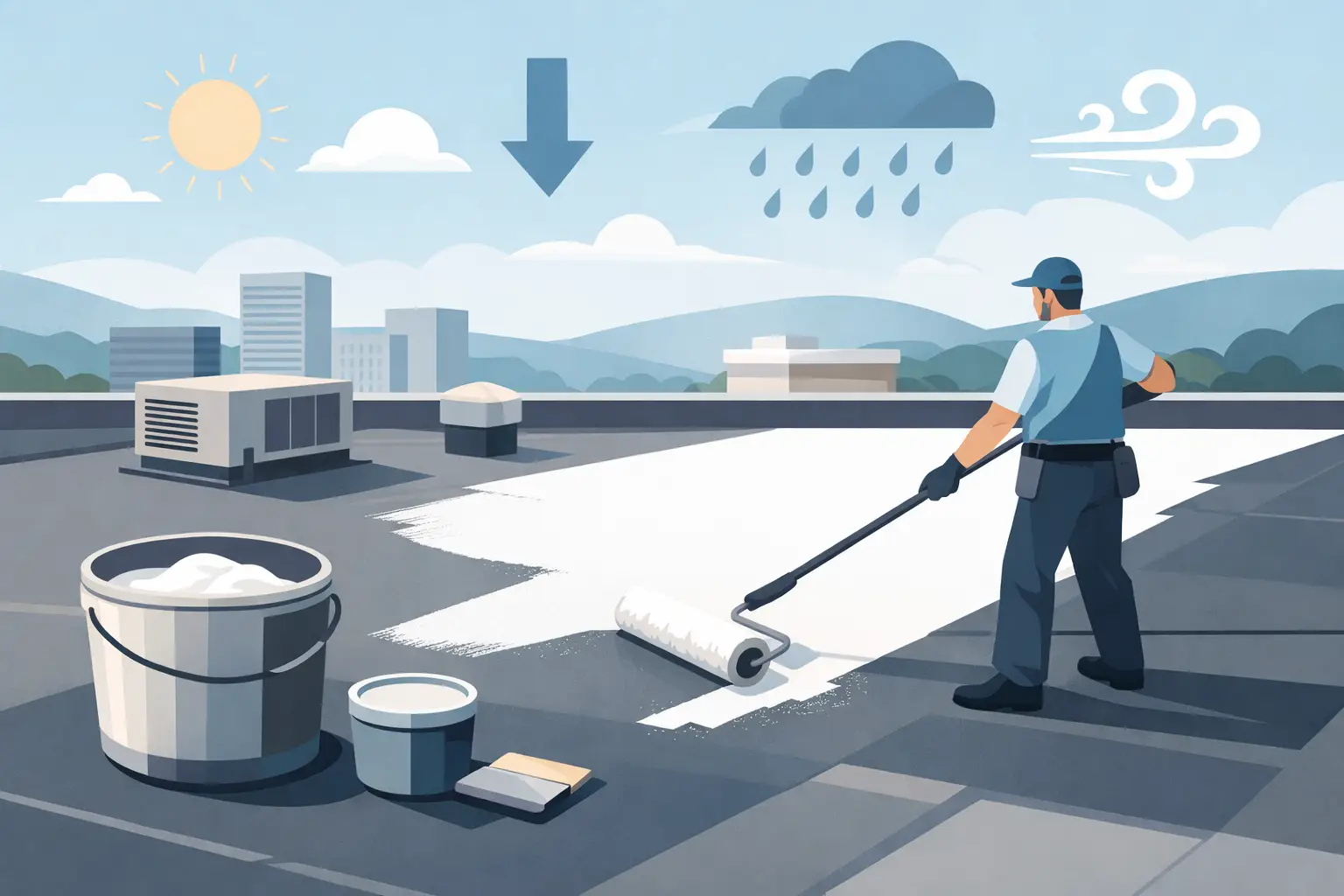
A flat roof that is leaking in one spot does not automatically need to be torn off. In many cases, a professionally installed coating can seal the roof surface, extend its service life, and reduce the immediate cost of a full replacement. Flat roof coating cost, however, is not a one-price-per-square-foot decision. The condition beneath the coating matters just as much as the coating itself.
For commercial building owners and property managers, the right question is not simply, “What does a coating cost?” It is, “Is this roof a good candidate for restoration, and what work is needed to make that restoration last?” A detailed inspection provides the answer and helps prevent a low initial price from becoming a short-lived repair.
What Is the Typical Flat Roof Coating Cost?
A professionally applied flat roof coating commonly falls in the range of about $3 to $8 per square foot, though some projects may fall below or above that range. Smaller roofs often have a higher per-square-foot price because setup, cleaning, repairs, detail work, and mobilization are spread across less area. Larger, open roof areas can be more efficient to coat, provided the existing surface is in suitable condition.
That range should be treated as a planning number, not a final quote. A roof with sound membrane, limited repairs, good drainage, and easy access may be a strong restoration candidate. A roof with saturated insulation, widespread membrane failure, standing water, or major structural concerns may need more than a coating can reasonably provide.
A clear estimate should separate the coating application from the preparation and repair work required beforehand. That is the best way to understand what you are paying for and avoid surprises once work begins.
Why Preparation Has Such a Big Impact on Price
Coatings only perform as well as the surface they are bonded to. If dirt, loose material, moisture, failing seams, or deteriorated flashing remain in place, even a quality coating can fail prematurely. Proper preparation is not an add-on. It is the foundation of the job.
A contractor may need to pressure clean the roof, remove loose existing coating, dry the surface, repair splits or punctures, reinforce seams, seal penetrations, and address deteriorated edge details before coating begins. On a low-slope roof, special attention is also needed around drains, scuppers, curbs, pipes, HVAC supports, skylights, and transitions between different materials.
This is why two roofs with the same square footage can receive very different proposals. One may need basic cleaning and localized seam work. The other may have years of deferred maintenance hidden beneath ponding water and surface debris. The second roof is not necessarily a poor candidate for restoration, but its preparation costs will be higher.
Existing Roof Material Matters
Flat and low-slope roofing systems are not all repaired or coated the same way. TPO and EPDM membranes require material-specific evaluation and preparation. The contractor must identify the membrane, check its condition, inspect seams and flashings, and use compatible repair methods and coating products.
An existing roof with a prior coating also deserves a closer look. If the earlier coating is still adhered well, it may be possible to clean, repair, and recoat it. If it is peeling extensively or separating from the membrane, removal and additional surface preparation can affect the final cost.
Moisture Can Change the Entire Scope
A coating is designed to restore and protect a roof surface. It cannot dry out wet insulation or repair deck damage underneath the membrane. When an inspection finds trapped moisture, soft areas, or widespread deterioration below the roof surface, targeted replacement of affected sections may be needed before restoration can move forward.
This does not always mean a complete tear-off is necessary. Sometimes localized repairs allow the remaining roof to be restored. Other times, the moisture problem is extensive enough that replacement is the more responsible long-term investment. A contractor who identifies that difference early is protecting your building, not just selling a coating job.
Flat Roof Coating Cost Factors Beyond Square Footage
Square footage is the starting point, but it is rarely the full story. Roof access can affect labor and equipment needs. A ground-level building with open access is generally simpler than a roof requiring special lifting, restricted staging, or work around active tenants and equipment.
Roof shape also matters. A large rectangular roof is usually faster to prepare and coat than a roof with many penetrations, walls, equipment platforms, and changes in elevation. Each detail needs careful cleaning, sealing, and reinforcement because these areas are common sources of leaks.
Drainage is another important factor. Coatings can help protect a roof, but they do not correct poor slope or solve serious ponding water on their own. If water remains on the roof for long periods after rainfall, the estimate may need to include drain cleaning, drain repairs, tapered materials, or other drainage corrections. Addressing that issue may raise the project price, but it can also protect the coating system and reduce future leak risk.
The thickness and number of coating passes also influence cost. A contractor may recommend a specific application rate based on the coating system, roof condition, and desired warranty coverage. A thinner application may cost less upfront, but it may not provide the same long-term performance as a properly specified system.
Coating Versus Replacement: Which Delivers Better Value?
A coating restoration can be an affordable alternative to complete replacement when the existing roof still has a sound foundation. It avoids much of the demolition, disposal, and disruption that comes with a full tear-off. It may also help building owners extend the useful life of a roof while planning for future capital expenses.
Replacement is usually the better choice when the membrane has widespread failure, insulation is saturated across large areas, the roof deck has concerns, or the roofing system has reached the point where repeated repairs are no longer practical. Coating over a roof that is fundamentally failing may delay the problem briefly, but it does not remove the cause.
The lowest estimate is not always the lowest cost over time. A cheap coating application that skips cleaning, seam reinforcement, moisture evaluation, or detail work can leave the building owner paying for repairs again much sooner than expected. On the other hand, a complete replacement may not be necessary when the existing roof can be restored correctly.
The best value comes from matching the solution to the roof’s actual condition.
What to Look for in a Flat Roof Coating Estimate
A useful estimate should make the project scope easy to understand. It should identify the roof areas being addressed, the preparation work included, repairs needed before coating, the coating system to be installed, and the cleanup and disposal plan. If portions of the roof are excluded, those exclusions should be clearly stated.
Ask how seams, penetrations, drains, flashing, and other roof details will be handled. These areas often determine whether a restoration holds up over time. You should also ask whether the contractor found signs of trapped moisture or damaged insulation, and how those conditions would be addressed if discovered during the project.
Warranty information belongs in the conversation as well. A warranty has value when the roof is properly prepared, the specified materials are installed at the required application rate, and the contractor stands behind the workmanship. Make sure you understand what is covered, how long coverage lasts, and what maintenance may be expected after installation.
For building owners in Durand and nearby communities, a local contractor can also provide practical advantages. They understand the effects of Michigan freeze-thaw cycles, heavy rain, snow loads, and seasonal temperature swings on low-slope roofs. Responsive follow-up matters when a roof protects an occupied building, inventory, equipment, or tenants.
When to Request an Inspection
Request an inspection if you see recurring leaks, cracked or peeling coating, open seams, ponding water, bubbling surfaces, loose flashing, or water stains inside the building. It is also wise to inspect an aging flat roof before a small issue turns into wet insulation or interior damage.
DLR Construction provides detailed, line-item estimates so property owners can compare restoration, repair, and replacement options with a clear understanding of the work involved. A free estimate should give you more than a number. It should give you a practical path forward for protecting the building without paying for work the roof does not need.
A well-timed coating project can preserve a serviceable roof and put off replacement for years. The right time to explore it is while the roof is still repairable, not after water has found its way into everything below it.