
A low-slope roof can look simple from the ground, but the membrane chosen for it affects repair costs, energy performance, and how well the building handles standing water, heat, and winter weather. When comparing TPO versus PVC roofing, the right answer is rarely just the material with the lower initial price. The roof’s use, drainage, existing condition, and exposure to grease or chemicals all matter.
For many commercial buildings in Mid-Michigan, TPO is a practical and cost-conscious choice. PVC can be the better investment where the roof faces demanding conditions that TPO is not designed to handle as well. A clear inspection and a detailed estimate help separate a good fit from a shortcut.
What TPO Roofing Is
TPO stands for thermoplastic polyolefin. It is a single-ply membrane commonly installed on commercial flat and low-slope roofs. Most TPO membranes are white or light-colored, which helps reflect sunlight and reduce heat absorbed by the roof surface.
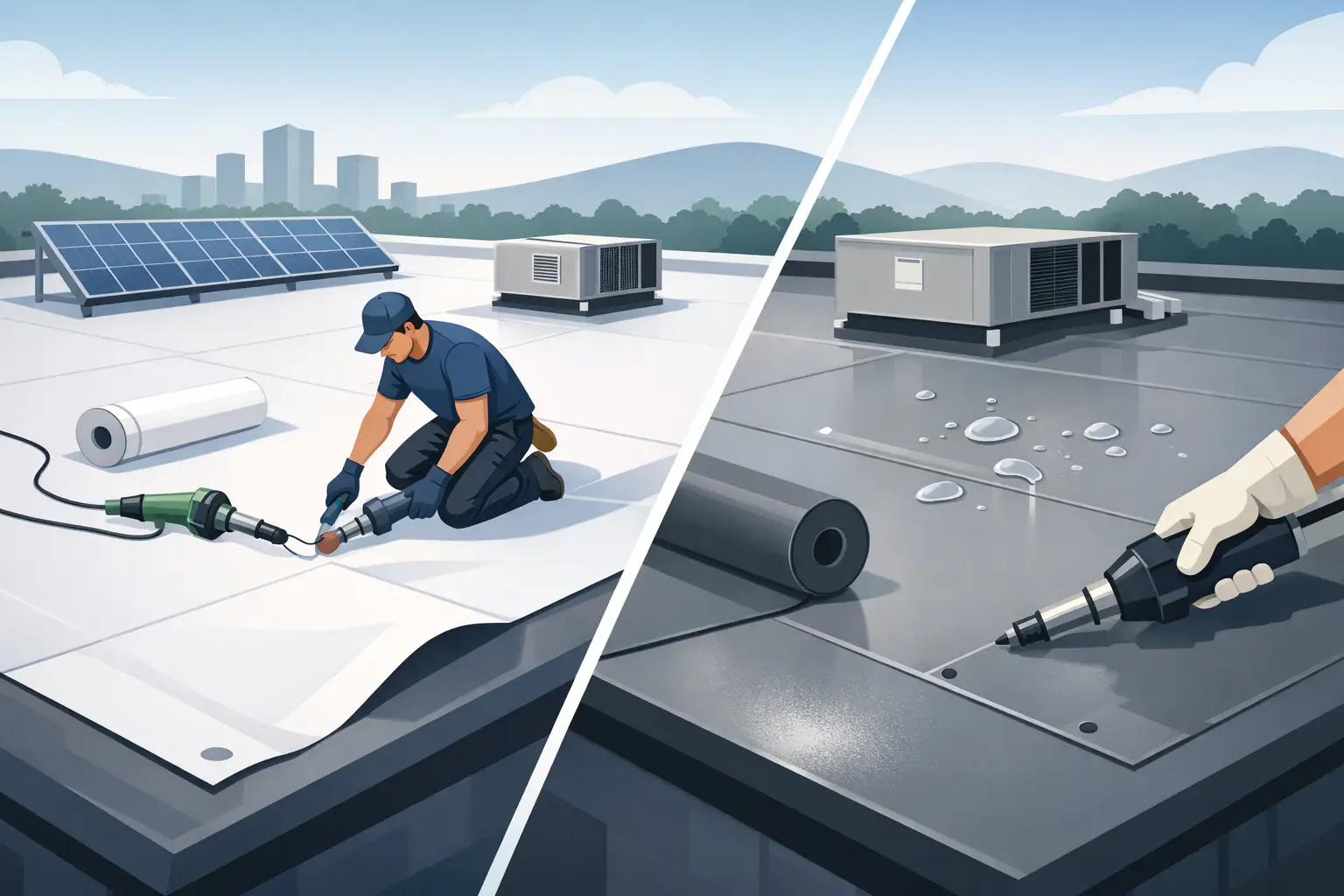
The membrane is installed in large sheets. Its seams are heat-welded, creating a continuous waterproof bond when the installation is performed correctly. TPO may be mechanically attached, fully adhered with adhesive, or installed as part of a ballasted system, depending on the building and roof assembly.
TPO has become a common choice because it offers solid weather resistance, heat-welded seams, and a competitive installed cost. For offices, warehouses, retail buildings, and other roofs without unusual chemical exposure, it often delivers the balance owners are looking for.
What PVC Roofing Is
PVC, or polyvinyl chloride, is another single-ply membrane with heat-welded seams. Like TPO, it is commonly used on low-slope commercial roofs and is available in reflective colors, including white.
The key distinction is chemistry. PVC has a longer track record in environments where oils, grease, animal fats, and certain chemicals may reach the roof. That makes it a frequent choice for restaurants, food-processing facilities, and buildings with kitchen exhaust systems.
PVC membranes are often more flexible and may perform especially well around detailed penetrations, curbs, and transitions when installed by an experienced roofing crew. That does not make PVC automatically better for every property. It does mean the building’s operations should be part of the roofing conversation.
TPO Versus PVC Roofing: The Main Differences
TPO and PVC share several strengths. Both are single-ply systems, both can have reflective surfaces, and both rely on heat-welded seams rather than tapes or loose-lap joints. Yet their differences can affect the roof’s long-term value.
Cost and budget planning
TPO generally costs less than PVC, making it attractive for property owners who need a dependable membrane system while keeping replacement costs under control. If the building has ordinary commercial use and good drainage, TPO may provide the performance needed without paying for chemical resistance the roof will never use.
PVC usually has a higher material cost. The additional expense can make sense when grease, oils, or chemical discharge are regular concerns. Replacing a membrane prematurely because it was not suited to the building’s use is rarely a savings.
Price comparisons should account for more than membrane cost. Tear-off requirements, wet insulation replacement, flashing details, drain work, edge metal, rooftop equipment, and access all change the final project price. A line-item estimate helps property owners see what is included before work begins.
Resistance to chemicals and grease
This is often the deciding factor. PVC is widely recognized for its resistance to grease, oils, and many chemicals. On a restaurant roof, for example, grease-laden exhaust can settle around fans and ducts. Over time, that exposure can damage roofing materials that are not made for it.
TPO is not the first choice for roofs with consistent grease or chemical exposure. It can still be appropriate in many settings, but a contractor should identify any exhaust discharge, manufacturing process, or rooftop activity that could affect the membrane. Sometimes the solution includes better containment or protection around a problem area. Other times, PVC is the more responsible recommendation from the start.
Cold weather and flexibility
Michigan roofs deal with more than summer sun. Freeze-thaw cycles, snow load, ice, wind, and sudden temperature changes all test seams, flashings, drains, and penetrations.
Both systems can perform well in this climate when they are properly designed and installed. PVC is generally known for retaining flexibility over a wide temperature range. TPO has also improved substantially over the years, but product quality and installation details matter. Not all membranes have the same thickness, formulation, warranty coverage, or performance history.
A roof membrane is only one part of the system. Insulation layout, vapor considerations, drainage slope, perimeter fastening, and flashing workmanship are just as important to keeping water out.
Seams and leak protection
TPO and PVC seams are heat-welded with specialized equipment. A properly welded seam is a major advantage of both systems because it creates a strong, fused connection between sheets.
Still, seams are only as reliable as the installer’s process. Temperature, speed, surface preparation, test welds, and consistent workmanship all affect the finished bond. Corners, pipe boots, drains, curbs, and roof edges require particular attention because those areas see movement and water concentration.
For a building owner, this is why the comparison should not stop at brand names or membrane thickness. Ask how the roof will be attached, how seams will be tested, how penetrations will be flashed, and what happens if hidden wet material is found during tear-off.
When TPO Is Usually the Better Fit
TPO is often a strong choice for general commercial buildings with low-slope roofs, particularly where the roof does not receive grease or harsh chemical exposure. It is commonly selected for offices, storage facilities, retail spaces, and similar properties where owners want a reflective, heat-welded membrane at a practical price.
It can also make sense when the existing roof has reached the end of its service life and the owner needs a complete replacement that addresses leaks without adding unnecessary cost. The best TPO system is not simply the least expensive bid. It is a complete assembly with proper insulation, secure attachment, correct flashing, and drainage addressed where needed.
When PVC Is Worth the Added Cost
PVC deserves serious consideration when the building use creates a known risk to ordinary membranes. Restaurants are the clearest example, but they are not the only one. Food production, some industrial processes, and rooftop areas exposed to oils or chemicals may justify the extra investment.
PVC may also be a smart choice for owners who prioritize long-term membrane flexibility and have a roof with many detailed penetrations. The material alone does not eliminate leaks, but a properly installed PVC system can offer excellent protection in demanding applications.
If there is uncertainty, start with a roof inspection and a discussion about how the building operates. A good contractor should explain why one system fits the conditions rather than pushing the same membrane on every roof.
Do Not Overlook Drainage and the Existing Roof
Neither TPO nor PVC is a cure for a roof that holds water because drains are blocked, insulation has settled, or the structure lacks adequate slope. Ponding water can shorten the life of any roof system and make small defects more serious.
Before selecting a membrane, inspect the roof for saturated insulation, deteriorated decking, open seams, failed flashings, and drainage issues. In some cases, a repair or restoration coating may be appropriate if the existing roof is dry and structurally sound. In other cases, a complete tear-off is the better path because the roof system beneath the membrane has already failed.
This is where an honest assessment matters. A lower-cost option is only valuable if it solves the actual problem.
Choosing a Roofing Contractor Matters as Much as Choosing the Membrane
TPO and PVC are technical commercial systems. Their performance depends on correct substrate preparation, attachment method, seam welding, flashing details, and cleanup after the project is complete. A membrane installed over unaddressed moisture or poorly detailed at penetrations can leak regardless of its label.
For property owners in Durand and surrounding communities, DLR Construction provides detailed commercial roof evaluations and estimates so there are no surprises about tear-off, disposal, protection measures, repairs, or warranty information. The goal is to recommend the system that fits the building, budget, and exposure conditions – not to force a one-size-fits-all answer.
A sound roofing decision starts with looking beyond the surface. If your building needs a low-slope roof replacement, ask what the roof is exposed to, where water travels, and how the full system will be installed. Those answers will point you toward a roof that protects the property long after the crew has left.